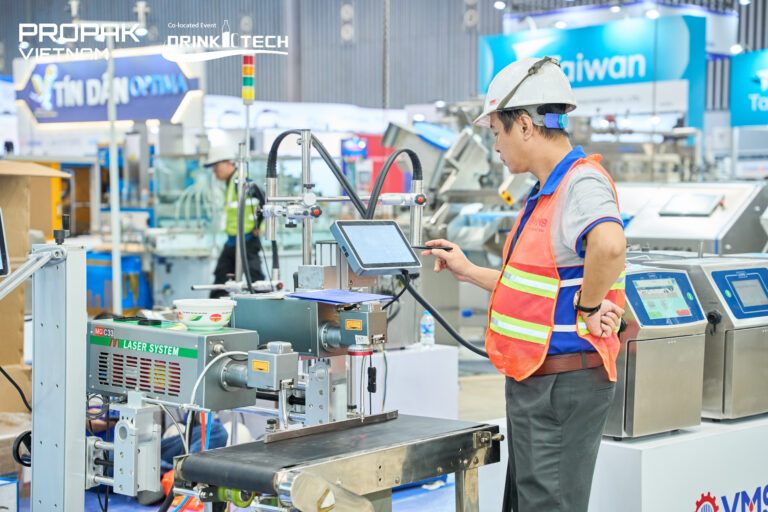
Demand for technology investment in Vietnam’s food industry is growing in line with production. According to figures cited by Dr. Nguyễn Duy Lâm, President of the Vietnam Association of Food Science and Technology (VAFoST), at ProPak Hanoi 2026, the country’s industrial production index rose 9.2% in 2025, with manufacturing increasing by 10.5%.
Vietnam’s food equipment and technology market was estimated at approximately US$658.9 million in 2024, including around US$375.4 million in automation equipment. The comparable Southeast Asian market was estimated at US$3.8 billion.
The “Smart and Sustainable Technologies for Vietnam’s Food Industry” seminar at ProPak Hanoi 2026 showed that food manufacturers are moving from sourcing equipment towards finding solutions to specific production challenges.
Investment Priorities
According to Nguyễn Duy Lâm, food manufacturers are being pulled in several directions at once. Consumers expect higher standards of safety, quality, and convenience. Export markets set higher expectations for traceability and environmental performance. Pressure on energy use, cold storage, and transport is mounting, while businesses must still work within practical constraints around capital, technical skills, and operating capability.

This puts economics at the centre of technology investment. In a Q4 2024 survey of food processing businesses cited during the seminar, 50.3% of respondents called for lower interest rates, highlighting the financial pressure surrounding new investment.
Technology therefore has to demonstrate its value through performance. A drying system, for example, needs to achieve the required consistent moisture level, maintain product quality, operate at a reasonable energy cost, and support future capacity expansion. Cold storage needs to preserve quality throughout the cold chain. Packaging must extend shelf life, reduce losses, ensure food safety, and align with environmental requirements.
Nguyễn Duy Lâm’s presentation identified six areas with clear demand: post-harvest technology, drying and cold chains; non-thermal processing and extraction; advanced packaging and quality monitoring; automation and process control; energy, water and resource efficiency; and production digitalization, traceability and optimisation.

Operational Efficiency
Phan Văn Hiệp’s presentation on agricultural drying illustrated how a production need translates into a technology brief. The requirements included capital and operating costs, product quality, food safety and hygiene, versatility, ease of use, labor, and factory space.
For a system designed to process three tonnes of fresh dragon fruit, for example, one cold-drying option presented at the seminar was around VND 4 billion, compared with VND 900 million for a solar-based drying system of the same capacity. At a 50 kg product scale, the presentation compared a heat-pump dryer consuming 7.2 kW with a solar-based system using 0.6 kW.
These figures are from specific solutions presented during the seminar rather than industry-wide benchmarks, but illustrate an important point: capital expenditure and energy consumption can fundamentally determine whether a technology is commercially viable for a manufacturer.
The system presented also combined inlet and outlet dehumidification, airflow management, temperature control, UVC treatment for microbial and mould control, microprocessor-based control, IoT connectivity, and direct energy measurement. Operators could monitor the system remotely and track energy consumption during drying.
This is where digital capability becomes useful in practical terms. Recording temperature, humidity, drying time, and energy use gives manufacturers a basis for comparing batches, reducing quality variation, and developing operating parameters for different raw materials.
Maximizing Value From Raw Materials
Further opportunities for technology lie in the value lost before and after processing. According to figures cited by Hoàng Thị Lệ Hằng at the seminar, Vietnam’s agricultural, forestry and fishery exports reached US$70.09 billion in 2025, up 12% from the previous year. Fisheries contributed US$11.32 billion, while fruit and vegetables accounted for US$8.56 billion. Her presentation noted that growth remained largely driven by volume and prices, leaving considerable room to create more value through deeper processing and better use of by-products.

Post-harvest losses were estimated at 20–30% for fruit and vegetables, 15–25% for fisheries products and 13–15% for rice. For every ten tonnes of fruit and vegetables harvested, two to three tonnes may never reach consumers. Reducing those losses therefore increases the value retained without requiring additional raw material inputs.
By-products offer a similar opportunity. The presentation proposed treating them as a factory’s “second source of raw materials” and recovering their components in order of value: high-value compounds first, followed by protein and fibre, then animal feed, fertiliser or energy. This approach requires separating, chilling, or otherwise stabilizing by-products at the factory, then processing them in stages instead of a single low-value use.

Shrimp heads and shells provide one example. The seminar materials showed that this material can contain chitin, protein, and minerals, along with smaller quantities of astaxanthin and lipids. A sequential process could recover astaxanthin and lipids, then proteins or peptides, minerals, and finally chitin, turning it into chitosan or glucosamine.
This approach broadens the definition of factory efficiency. Alongside finished-product output, manufacturers can track how much of the original raw material’s value is retained across the entire processing operation.
A Roadmap for Production Digitalization
Digitalization connects equipment, processes, and production data. Hoàng Thị Lệ Hằng’s framework divides digital technology into four layers: in-line measurement using IoT sensors, spectroscopy, or machine vision; predictive modelling and optimization; digital twins; and traceability and supply-chain data management.
Implementation was organized into three stages. The first is digitizing batch data by replacing paper logs with electronic records, assigning batch codes, and recording production parameters and test results. Once the data is sufficiently reliable, manufacturers can move into offline prediction and optimization, followed later by closed-loop control and digital twins.
The presentation also noted that machine-learning models are reliable only within the range of data used to develop them and cannot replace process validation for food safety. For food manufacturers, establishing reliable data about their own production processes is the first step towards a smart factory.

Integrating Technologies Across Production
The technologies presented at the seminar ranged from smart drying, non-thermal processing and green extraction to IoT, machine learning and traceability. Value comes from connecting these technologies within a single production process, from raw material handling to data management.
Hoàng Thị Lệ Hằng proposed using raw materials through two processing streams. One produces the main product, while the other separates by-products early for further processing into valuable products. Connecting data from both streams allows manufacturers to monitor, optimize, and trace the entire production process. The model was suggested for shrimp, pangasius, and tropical fruit supply chains.
This also explains why production strategy should include innovation, green transformation, and digitalization altogether. Innovation supports higher-value processing and products. Green transformation focuses on energy, water, raw materials, and by-products. Digitalization enables businesses to collect data, monitor processes, optimize operations, and strengthen traceability.
For Vietnam’s food technology market, solutions must deliver specific production results, match investment capacity, and integrate with existing systems. The question before each investment is therefore: what does the factory need to improve – productivity, quality, material losses, energy use, traceability, or the value recovered from raw materials? Answering that question gives manufacturers a basis for choosing the right technology, the appropriate level of automation, and a realistic investment roadmap.
Discover Solutions at ProPak Vietnam 2027
As food manufacturers seek to improve production efficiency, reduce raw material losses, and optimize operating costs, finding technologies that address real factory needs is becoming increasingly important. At ProPak Vietnam 2027, visitors can explore processing, drying, packaging, and automation technologies, stay updated on industry trends, and engage directly with experts through seminars.
Explore more about the event here.
Sources
“Smart and Sustainable Technologies for Vietnam’s Food Industry” seminar